“Could this have been prevented?”
That’s the haunting question every technology leader and compliance officer asks after a major failure — when systems go down, customer data is exposed, or auditors uncover gaps that should have been caught months earlier.
Take one example: a Fortune 500 global bank fined $1.5 billion for failing to maintain effective monitoring controls in its IT and anti-money laundering systems.
The real story wasn’t about one bad decision — it was about years of weak system oversight, outdated monitoring tools, and missing configuration checks that allowed risks to pile up unnoticed.
By the time the alarms went off, the damage was done — reputation shattered, leadership replaced, and regulators imposing years of heightened scrutiny.
And here’s the uncomfortable truth: this could happen to any large enterprise struggling to keep up with modern tech compliance demands.
This story isn’t about banking — it’s about how fragile technology governance can become when compliance is reactive instead of proactive.
The GRC Reality Check in 2025
Today’s compliance challenges are no longer about paperwork — they’re about technology control assurance at massive scale.
🔹 Exploding regulatory and framework obligations
A single enterprise IT environment must align with dozens of overlapping frameworks — ISO 27001, NIST CSF, PCI-DSS, CSCRF, SOX ITGC, and regional data laws like GDPR or DPDP India.
Each change in configuration, cloud policy, or access control may trigger new compliance checks.
🔹 Data overload
Technology GRC teams must monitor millions of system logs, access events, and configuration changes across hybrid environments.
Manual review of backup reports, server patching, and firewall settings? Practically impossible.
🔹 Fragmented tools
Risk, audit, and compliance data often live in separate systems — ServiceNow for ITSM, Excel for audits, Splunk for security, and GRC tools for risk reporting.
Without integration, no one gets a unified view of compliance posture.
🔹 Human limitations
Even the most skilled compliance analysts can’t manually track thousands of controls across apps, endpoints, and servers. Fatigue leads to errors — and one missed alert can mean downtime or breach.
🔹 Mounting accountability
Boards, regulators, and customers now demand proof — not just policy. “Are backups actually verified?” “Is 2FA enforced everywhere?” “Are configurations hardened to CIS standards?”
Excuses no longer suffice.
In short: Technology GRC today is complex, continuous, and unforgiving.
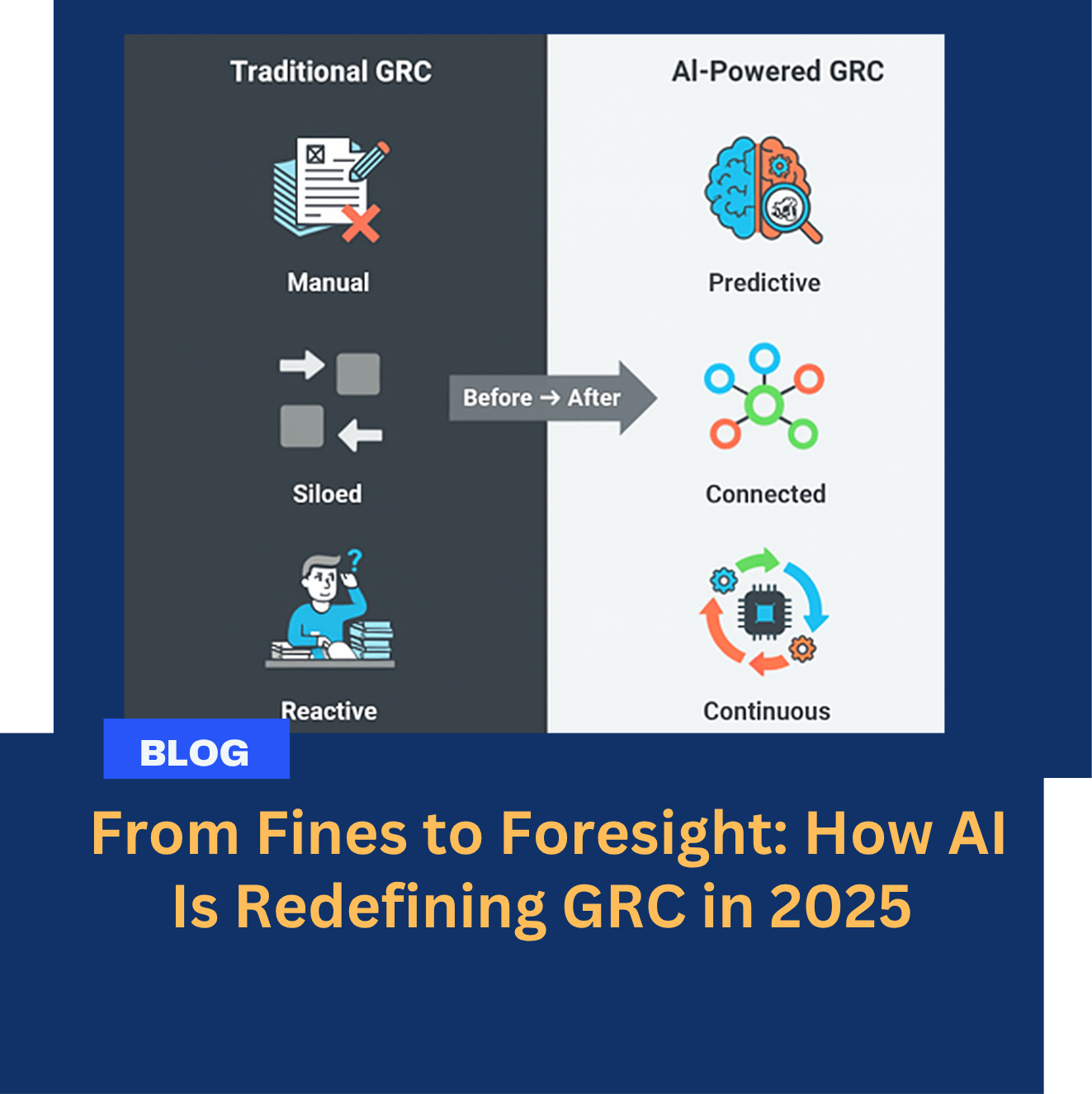
And traditional, manual approaches can’t keep pace with the velocity of digital change.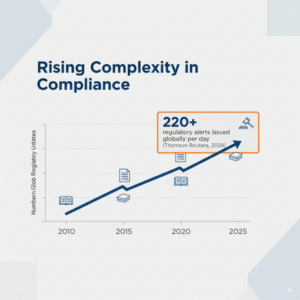
Where AI Steps In
AI is redefining Technology GRC — turning reactive controls into predictive intelligence.
Here’s how it’s changing the game:
- Early risk detection: AI models continuously analyze system logs and configuration drift to identify anomalies — before they turn into incidents.
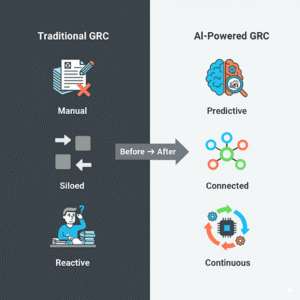
- Predictive compliance: Machine learning predicts which controls are most likely to fail (for example, backup verification gaps or repeated patching delays).
- Smart automation: AI-driven bots can check control evidence — e.g., “Are all servers backed up?” or “Is encryption enabled on all databases?” — in real time.
- Unified visibility: Natural Language Processing (NLP) can extract compliance insights from audit documents, incident reports, and monitoring data to build a single GRC dashboard.
- Continuous assurance: Instead of waiting for quarterly audits, AI allows always-on monitoring across systems and policies.
💡 According to Deloitte (2024), organizations using AI in compliance operations have reduced manual effort and cost by up to 30%.
Source: Deloitte. Harnessing Generative AI for Regulatory Compliance (2024). The State of AI in Compliance.
The Payoff: From Cost to Strategic Edge
Traditionally, compliance has been viewed as a necessary burden — a cost center that slows innovation.
AI changes that narrative.
With automation and intelligence at its core, Technology GRC can now: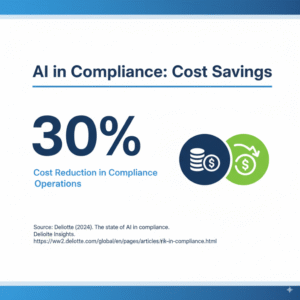
- Detect control failures instantly (instead of months later in audits)
- Reduce downtime and incident response times
- Build digital trust by proving compliance continuously
- Empower leadership with real-time assurance dashboards
- Shift compliance from cost to competitive differentiator
In short, AI helps compliance become a growth enabler rather than a blocker.
Why This Blog Series?
This is just the beginning of our deep dive into AI-powered Technology GRC.
In the upcoming parts, we’ll explore:
- Real-world examples of AI in tech compliance (cloud security, backup validation, access governance, configuration audits).
- The dark side of AI in GRC — including bias, explainability, and regulatory skepticism.
- Future-proofing compliance teams — how roles will evolve as AI automates control testing.
- Actionable steps for organizations starting their AI-driven compliance transformation.
Final Thought
In 2025, compliance is no longer about checking boxes — it’s about continuous digital trust.
The organizations that harness AI to monitor, predict, and prevent compliance failures will lead the next era of resilient, transparent technology governance.
The real question isn’t “Will AI reshape GRC?”
It’s “Will your organization be ready to harness it — before the next incident happens?”
Reference Highlights