
Beacon Scanner: Personal Data Discovery & Inventory for Digital Privacy Compliance
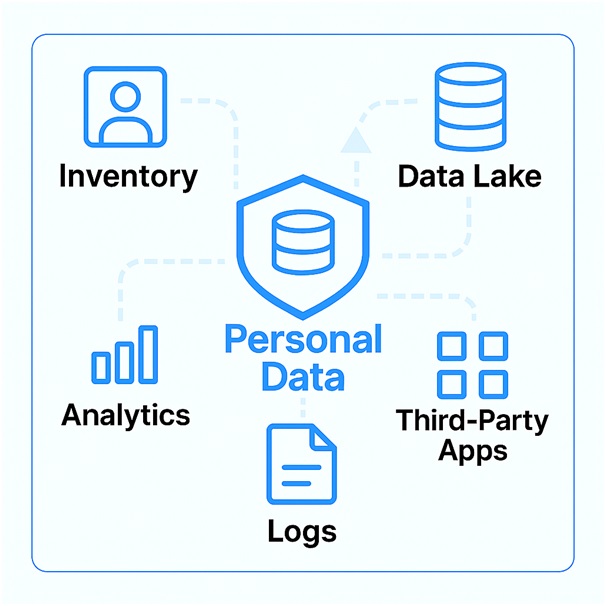
Personal data discovery is the process of automatically locating, classifying, and tracking personal data across CRMs, data lakes, endpoints, and outside partner integrations. It runs continuously, not once a year.
Personal Data Discovery Breaks Down at Scale
Personal data is everywhere. Visibility into it usually isn’t.
Personal data sprawls across CRMs, data lakes, logs, analytics tools, and outside partner integrations. Static audits and manual spreadsheets can’t keep pace, and the gaps regulators penalize most are the ones nobody is actively tracking.
- Continuous shadow data scanning. Legacy systems and shadow IT often hide personal data nobody documented. Beacon Scanner scans for it continuously, so it surfaces on its own instead of turning up during a regulator’s review.
- An inventory that stays current. A periodic audit is only accurate for the day it’s taken, since the environment keeps changing underneath it. Beacon Scanner replaces that snapshot with an inventory that updates itself as new data sources appear.
- A defensible record for DPDPA and GDPR. Enforcement actions typically trace back to the absence of an automated data inventory a team can point to. Beacon Scanner keeps one, continuously, with evidence behind every entry.
Beacon Scanner Approach
Scanning powered by AI that keeps pace with your data
1. Comprehensive data discovery
Most teams assume PII discovery needs a separate tool bolted onto existing systems. Beacon Scanner scans the CRMs, data lakes, endpoints, and outside partner integrations you already run using pattern recognition and contextual analysis, including systems that never made it into the last manual inventory.
2. Validation of trusted systems
Confirms data presence in approved environments, closing the loop between what should exist and what actually does. That loop is the foundation of accurate data mapping.
3. Continuous, not periodic
A true continuous data discovery tool: scans on an ongoing basis, flagging new data sources as they appear rather than waiting for the next audit.
4. An inventory that's always current
Maintains a continuously updated data inventory ready for audit through automated scanning, so the record shown to an auditor is true right now.
5. Built for change
Scales automatically as a PII discovery tool across new systems, endpoints, and integrations, so coverage doesn’t erode as the environment changes.
How Beacon Scanner Compares
Where Beacon Scanner fits relative to other approaches to personal data discovery
Vs. point solutions
automated scanning instead, so the inventory doesn’t go stale between review cycles.
Vs. enterprise suites
Enterprise privacy suites are built as full workflow platforms covering far more than discovery alone. Beacon Scanner focuses specifically on automated discovery and an inventory ready for audit, fitting teams that don’t want to adopt an entire GRC suite just to get there.
Value Delivered
If a regulator asks for our data inventory under DPDPA or GDPR, what actually needs to be in it?
An inventory reflecting the current state of personal data: where it lives, what systems hold it, and evidence of how that was determined, not a static document assembled from memory or spreadsheets. Beacon Scanner keeps exactly that, mapped directly to evolving requirements including emerging DPDPA data inventory obligations, with an evidence backed trail behind every entry.
Reduced risk exposure
Continuous shadow data discovery means fewer unknown or unauthorized data stores sitting outside your control.
Less manual overhead
Data inventory automation cuts the recurring cost of spreadsheet audits and closes the gap between review cycles.
Are we actually ready if an auditor or regulator asks tomorrow, not after we scramble to prepare?
Be prepared for a regulator or auditor request on any given day, not just after a scramble to reconstruct one.
Proof
Large telecom and financial services organizations have used scanning approaches powered by AI similar to Beacon Scanner to uncover data locations missed during years of manual assessments.
Shadow systems surface early.
Most of the manual discovery effort disappears in the first few scan cycles, when legacy tools and shadow IT that never made it into a spreadsheet inventory show up on their own.
Evidence stops being a scramble.
Teams that used to spend weeks pulling logs before an audit or a customer security review now pull from an inventory that’s already current.