
Regulatory Change Monitor
Understand regulatory change and act with confidence, supported by continuous monitoring, SIEM, HRM driven insights, and real time impact visibility.
Where Things Break
Regulations change faster than compliance teams can respond
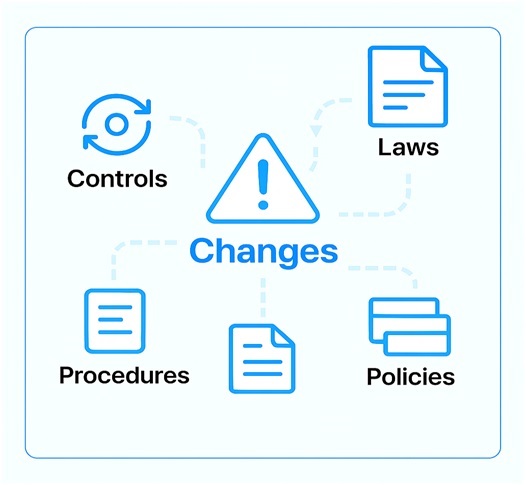
Regulatory change is constant. New laws, amendments, circulars, and clarifications are issued frequently, often with short implementation timelines. Compliance teams must quickly understand what has changed and how existing controls, policies, and procedures are affected often without real-time monitoring or visibility into actual control performance.
- Manual interpretation is slow and inconsistent across teams without centralized intelligence and monitoring insights
- Teams overreact by updating too much or miss critical gaps entirely due to lack of prioritized signals
- Short implementation timelines leave little room for thorough analysis without automation and real-time visibility
- Regulators globally cite inadequate impact assessment as a key program weakness, especially where monitoring and control validation are limited
Sigmify GRC Approach
AI‑driven regulatory impact analysis built for precision
1. Centralized regulatory intelligence
Maintains an up-to-date regulatory library across jurisdictions, enriched with continuous updates and integration with monitoring systems for better visibility
2. Automated obligation extraction
Identifies relevant requirements from new publications, supported by AI-driven parsing and alignment with system and compliance data
3. Impact mapping
Compares new regulations against existing controls and policies, leveraging system data and monitoring insights to understand real-world impact
4. Gap & overlap detection
Flags what is missing, partially covered, or redundant, enhanced with visibility from control performance and audit signals
5. Actionable change guidance
Converts analysis into clear remediation and update actions, aligned with workflows and supported by alerts and monitoring triggers
Value Delivered
From reactive interpretation to structured response
1. Faster impact assessments
Move from weeks of manual review to days using automated analysis, centralized intelligence, and real-time monitoring insights
2. Targeted updates
Change only the controls and policies that matter, guided by precise impact mapping and visibility into actual system behavior
3. Clear ownership
Assign remediation actions with confidence using structured workflows, alerts, and clear accountability
4. Audit ready posture
Defensible, traceable regulatory response decisions supported by documentation, monitoring data, and system-level evidence
Proof
Measured results in regulated environments
Organizations using automated regulatory impact mapping have:
Reduced regulatory response timelines by weeks
Improved consistency in impact assessments
Entered audits with clearer justification and documentation
Proof
Proven outcomes across industries
Uncovered data missed during years of manual tracking
50%+
Improved response timelines significantly